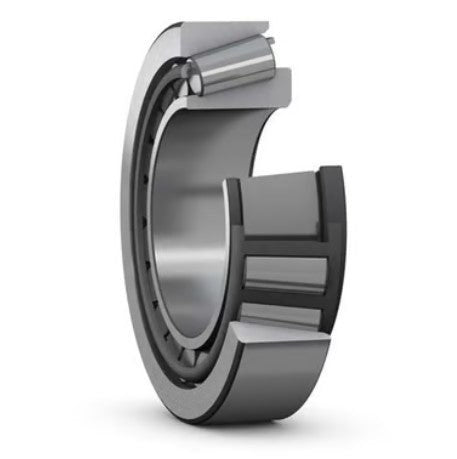
32028
Tier-one manufacturer — brand supplied may vary ✓ Verified against manufacturer sourcesCouldn't load pickup availability

Image is for illustration purposes only.
What 32028 means
| Code | Position | Meaning |
|---|---|---|
3 |
Type | Tapered roller bearing (metric) |
2 |
Width series | Width series 2 |
0 |
Diameter series | Diameter series 0 (extra light) |
28 |
Bore | Bore code 28 × 5 = 140 mm |
Read from the ISO / ABMA numbering rules and the makers' published suffix conventions. Decode any other number with the bearing number decoder.
32028 specifications
| Specification | Metric | Inch | Basis |
|---|---|---|---|
| Bore (d) | 140 mm | 5.5118 in | ISO table for this designation, confirmed by supplier data |
| Outside diameter (D) | 210 mm | 8.2677 in | Supplier catalogue listing |
| Width, assembled (T) | 45 mm | 1.7717 in | Supplier catalogue listing |
| Bearing type | Tapered roller bearing (metric, ISO 355) | Stated by the designation | |
| Seals / shields | Open (no seals or shields) | Stated by the designation | |
| Tolerance class | Normal (ISO P0 / ABEC 1): no tolerance-class code | Stated by the designation | |
Equivalent to / interchanges with
Also listed in manufacturer interchange tables (1): confirm suffix codes before ordering
- TIMKEN 32028XM (Timken Interchange Guide)
These carry maker-specific suffix codes (cage, lubrication groove, design) that we have not matched one-for-one. The size is the same; check the codes against your application.
Equivalents are dimensional and closure-for-closure: same bore, outside diameter, width, seals or shields and internal clearance. Bearing interchange tables
32028 is a tapered roller bearing (metric, ISO 355), 140 mm bore × 210 mm OD × 45 mm wide (5.5118 × 8.2677 × 1.7717 in).
The 32028 is a metric tapered roller bearing conforming to ISO 355 standards, featuring a 140 mm bore diameter. Tapered roller bearings use conical raceways and tapered rollers to handle combined radial and axial loads efficiently.