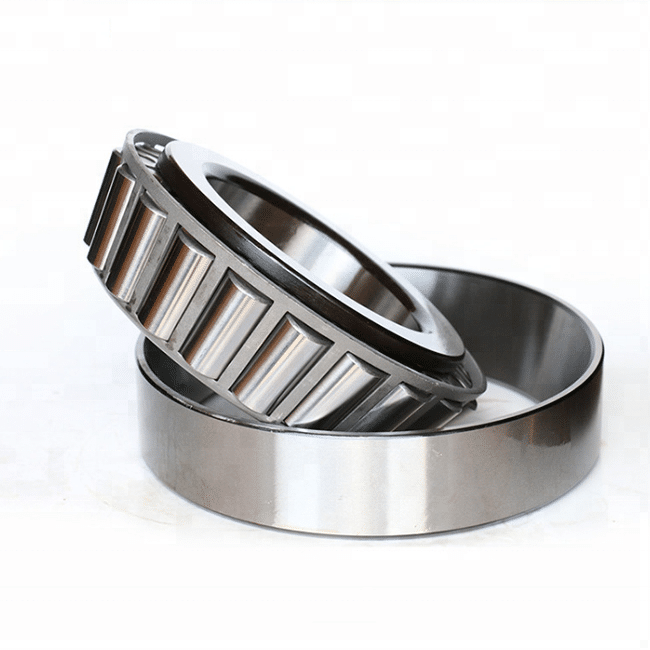
30221J
Tier-one manufacturer — brand supplied may vary ✓ Verified against manufacturer sourcesCouldn't load pickup availability

Image is for illustration purposes only.
What 30221J means
| Code | Position | Meaning |
|---|---|---|
3 |
Type | Tapered roller bearing (metric) |
0 |
Width series | Width series 0 |
2 |
Diameter series | Diameter series 2 (light) |
21 |
Bore | Bore code 21 × 5 = 105 mm |
J |
Cage | Pressed steel cage |
Read from the ISO / ABMA numbering rules and the makers' published suffix conventions. Decode any other number with the bearing number decoder.
30221J specifications
| Specification | Metric | Inch | Basis |
|---|---|---|---|
| Bore (d) | 105 mm | 4.1339 in | ISO table for this designation, confirmed by supplier data |
| Outside diameter (D) | 190 mm | 7.4803 in | Maker's catalogue (PEER Bearing), confirmed by supplier data |
| Width, assembled (T) | 39 mm | 1.5354 in | Maker's catalogue (PEER Bearing), confirmed by supplier data |
| Bearing type | Tapered roller bearing (metric, ISO 355) | Stated by the designation | |
| Seals / shields | Open (no seals or shields) | Stated by the designation | |
| Cage | Pressed steel cage | Stated by the designation | |
| Tolerance class | Normal (ISO P0 / ABEC 1): no tolerance-class code | Stated by the designation | |
Equivalent to / interchanges with
| Brand | Part number | Basis |
|---|---|---|
| TIMKEN | 30221M we stock this | Timken Interchange Guide |
Equivalents are dimensional and closure-for-closure: same bore, outside diameter, width, seals or shields and internal clearance. Bearing interchange tables
30221J is a tapered roller bearing (metric, ISO 355), 105 mm bore × 190 mm OD × 39 mm wide (4.1339 × 7.4803 × 1.5354 in). It has a pressed steel cage. Published interchange tables list it as equivalent to TIMKEN 30221M.
The 30221J is a metric tapered roller bearing conforming to ISO 355 standards, featuring a 105 mm bore diameter and belonging to the 302 series. Tapered roller bearings use conical rolling elements to handle combined radial and axial loads simultaneously, with load capacity increasing proportionally to the contact angle.