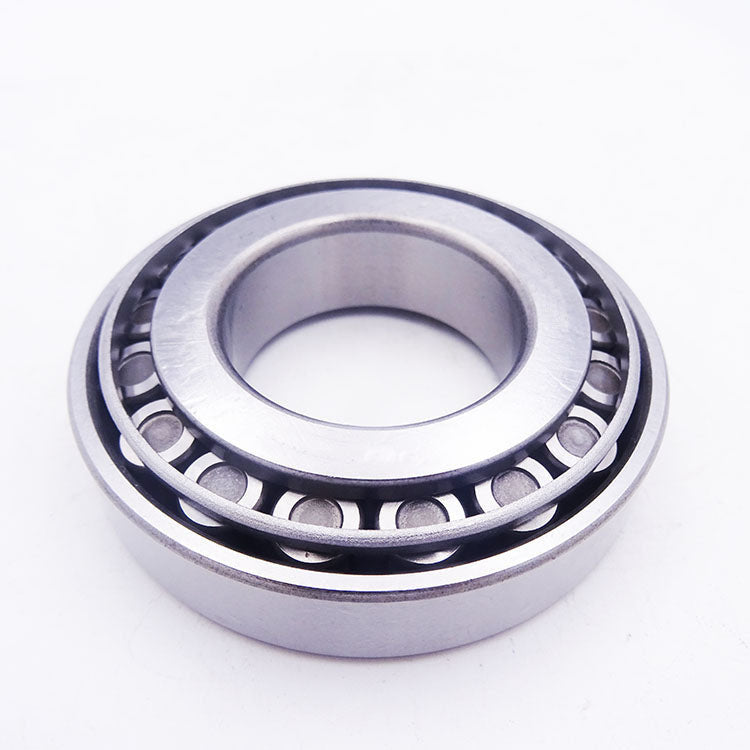
30216JR
Tier-one manufacturer — brand supplied may vary ✓ Dimensions checked: ISO table and supplier data agreeCouldn't load pickup availability

Image is for illustration purposes only.
What 30216JR means
| Code | Position | Meaning |
|---|---|---|
3 |
Type | Tapered roller bearing (metric) |
0 |
Width series | Width series 0 |
2 |
Diameter series | Diameter series 2 (light) |
16 |
Bore | Bore code 16 × 5 = 80 mm |
JR |
Maker code | Manufacturer-specific code, not decoded here. Ask us if it matters for your application. |
Read from the ISO / ABMA numbering rules and the makers' published suffix conventions. Codes marked "not decoded" are maker-specific; ask us if one matters for your application. Decode any other number with the bearing number decoder.
30216JR specifications
| Specification | Metric | Inch | Basis |
|---|---|---|---|
| Bore (d) | 80 mm | 3.1496 in | ISO table for this designation, confirmed by supplier data |
| Outside diameter (D) | 140 mm | 5.5118 in | Maker's catalogue (PEER Bearing), confirmed by supplier data |
| Width, assembled (T) | 28.25 mm | 1.1122 in | Maker's catalogue (PEER Bearing), confirmed by supplier data |
| Bearing type | Tapered roller bearing (metric, ISO 355) | Stated by the designation | |
| Seals / shields | Open | Supplier catalogue listing | |
Equivalent to / interchanges with
Also listed in manufacturer interchange tables (1): confirm suffix codes before ordering
- TIMKEN 30216M (Timken Interchange Guide)
These carry maker-specific suffix codes (cage, lubrication groove, design) that we have not matched one-for-one. The size is the same; check the codes against your application.
Equivalents are dimensional and closure-for-closure: same bore, outside diameter, width, seals or shields and internal clearance. Bearing interchange tables
30216JR is a tapered roller bearing (metric, ISO 355), 80 mm bore × 140 mm OD × 28.25 mm wide (3.1496 × 5.5118 × 1.1122 in).
The 30216JR is a metric tapered roller bearing with an 80 mm bore diameter from the 302 series. Tapered roller bearings use conical rolling elements to handle combined radial and axial loads, with load capacity proportional to contact angle.